
MYTHBUSTER SERIES
Setting the record straight
Short, evidence-backed reads that check widely repeated claims against the research.
MYTHBUSTER INDEX
Six common myths about having children
The common wisdom about fertility, age and family size doesn’t hold up. Click any myth to see what the evidence says.
Sources: Wynes & Nicholas 2017 · HFEA 2024 · Southampton fertility age-gap study · UN population projections 2024
-
Men face a decline in sperm count and quality as they age, and older fathers are more likely to have children with disorders.
-
The average UK age gap is only 2–3 years; gaps over 10 years are very uncommon.
-
A 90% chance of having 3 children without IVF requires starting at age 23. Infertility risk rises 36% between 30 and 35.
-
Success rates are around 1 in 6 for ages 40–42, and under 1 in 10 for 43–44.
-
The original claim used outdated, peak-era emissions data. Updated for current trends, restoring replacement fertility adds just 0.05°C by 2200.
-
Models and research show we can sustainably feed 10 billion+ people, above current population forecasts.
THE SERIES
Latest mythbusters
01 · ARTICLE
Having kids won’t hurt the planet
A once-viral statistic has scared a generation into smaller families. Here’s what newer research actually shows.
02 · ARTICLE
Can men just delay and marry younger? The data says no
Men are rarely told they’re on a clock. Here’s why waiting for a younger partner isn’t a plan.
03 · ARTICLE
Falling fertility isn’t about falling desire to have kids
People still want families. Here’s why so many end up with fewer children than they intended.
MYTHBUSTER · 4 MIN READ
Falling fertility isn’t due to a falling desire to have kids
THE MYTH
“Young people today simply don’t want to have as many children.”
The myth
Some read the data as showing that young adults will have fewer children because they want fewer children. Across the developed world, family sizes are shrinking, and some commentators put almost all of that down to changing preferences and rising costs.
The evidence
1. The birthrate has fallen but desire hasn’t. Stated preference for children has changed very little in the developed world since 1980. The number of children people have has dropped and the gap between what people say they want and what they end up with is growing.
2. People are falling short of their own goals. Current fertility rates are below fertility intentions! In the countries surveyed, fertility rates sit on average 0.13 children below fertility intentions. This means that people aren’t even having the children they intend to have, let alone the number they’d ideally want.
3. The obstacles are underestimated. The gap between expected and actual fertility shows people underestimate what stands in the way. Some obstacles are economic, but many are social. Among Americans over 50 without children, the most common major reason given is “it just never happened.” The second is not finding a partner (33%).
4. “Revealed preference” doesn’t work. Economists often argue that we should judge by what people do (their “revealed preference”), not what they say. But this argument doesn’t take the economics of family far enough! Social and legal norms around commitment are weaker than they used to be and this makes it harder for one partner to judge whether the other will be reliable and supportive. An uninformed agent is likely to make mistakes, and, outside of subcultures with stronger norms in favour of commitment, we are all uninformed agents now. This means that it is common for people to delay having children past their preference.
5. Key facts are widely misunderstood. Fewer than 1 in 5 young women realise how much IVF success drops at later ages. IVF pregnancy rates are around 1 in 6 at ages 40–42, and below 1 in 10 at 43–44 (clinics usually advertise the pregnancy rate as their “success” rate). Around 30% of graduates underestimate how much women’s fertility declines after 35. They also wrongly believe a man’s age has no effect on how quickly or whether conception happens.
6. Information changes plans. When young people are informed of the realities of biological risks, they move forward their intended timing of parenthood in two studies.
“It seems that information gaps are causing people to leave parenthood later than they would if properly informed.”
IN SHORT
Stated desire for children has barely changed since 1980, though the number of children people actually have has fallen.
People are having fewer children than they themselves intend.
Many don’t know how steeply fertility, and IVF success, decline with age, so they delay longer than they would otherwise.
BOTTOM LINE
Falling fertility is less about wanting fewer children and more about people underestimating how hard, and how time-consuming, it is to get set up for family life, which may itself have become harder. Many also lack basic information about how much time they really have.
Raising awareness of that time pressure speaks directly to the problem as it exists today.
MYTHBUSTER · 5 MIN READ
Can men just delay and marry younger? The data says no
Men are rarely told they’re on a clock. But their fertility and their partner’s both put real limits on how long they can wait before they start trying to have children.
THE CLAIM
“Men don’t need to rush since they don’t have a biological clock. If they want kids, they can simply settle down later with a younger partner.”
Why it stuck
There’s plenty of talk about the female biological clock, but very little about men’s. Many men want to have children and might even work to get themselves in a position to have them. Others say they want a family but don’t prioritise the things that would lead them there, like being in a committed relationship in time, because nobody tells them it’s urgent.
Unplanned childlessness among men is a growing issue, with more men reaching midlife without the family they hoped for.
What the evidence actually shows
Men have a clock too. Male fertility starts to decline from around 40. And in practice, men also have to plan around their partner’s clock.
Big age gaps are rare. In the UK the average age gap in heterosexual married couples is just 2–3 years, and gaps of over 10 years are very uncommon. Relying on finding a much younger partner isn’t a realistic plan for most men.
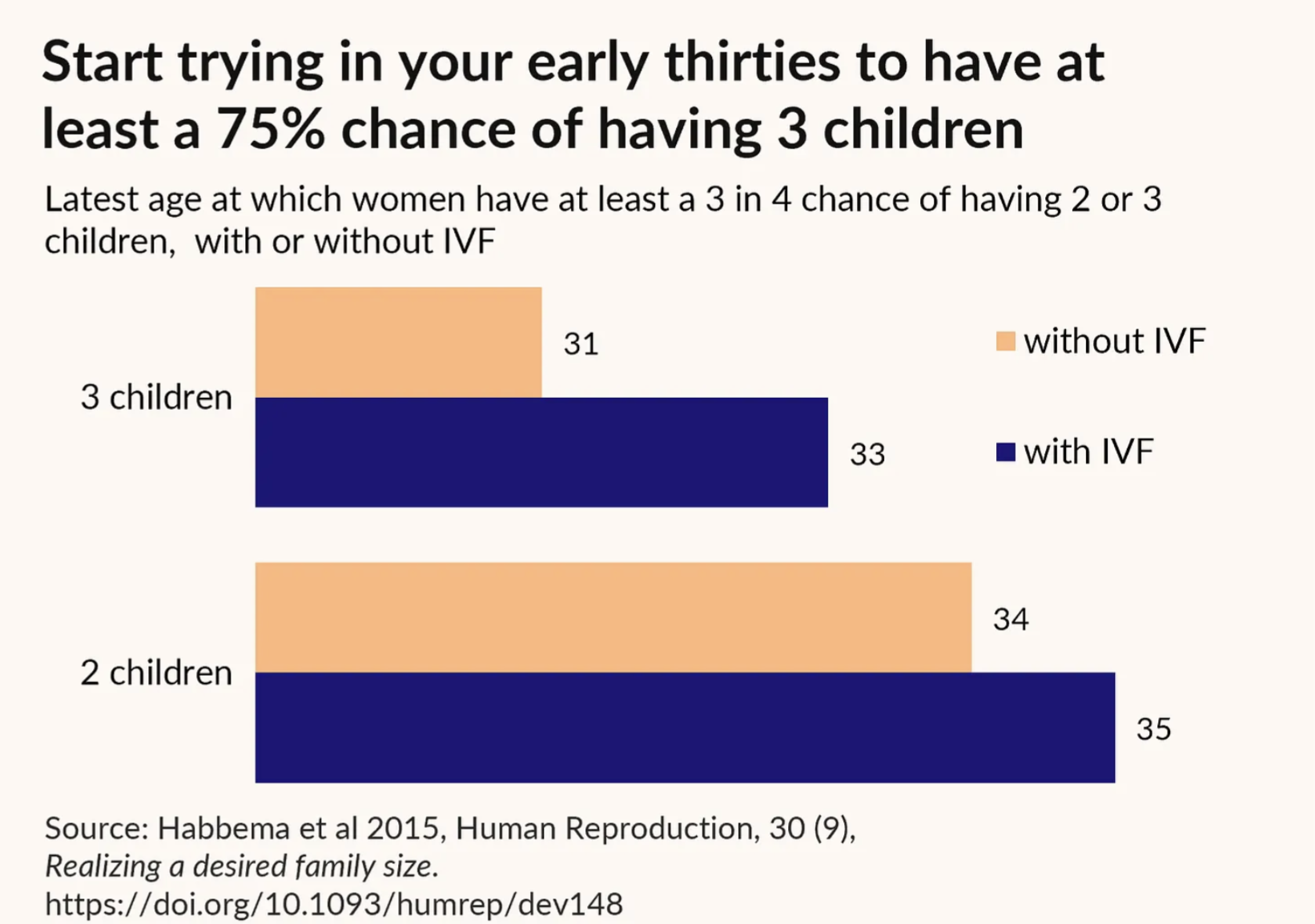
The timeline is tighter than it looks. In the UK, most people think that being together for two or three years is a reasonable wait before having children. To have a 75% chance of having two children naturally, a couple should start trying by the time she’s 34, when he’ll probably be around 36 years old. So the average man should to be with his partner by 33 or 34.
IVF only buys little time. Fertility treatment only adds a year or two for the same chances of the same outcome.
IN SHORT
Men have a biological clock too: male fertility declines from around 40.
In the UK, the average age gap in married couples is only 2–3 years. Gaps of over 10 years are very uncommon.
For a 75% chance of two children, a couple should start trying by the time she’s 34, when he’s likely around 36.
IVF only adds a year or two for the same chances.
2–3 yrs
The average age gap between husbands and wives in the UK. Relationships with gaps of over 10 years are very uncommon.
BOTTOM LINE
Men who want a family have less time than the culture often suggests. Waiting until later and hoping for a much younger partner is a gamble the numbers don’t support. If you want children, it matters for a man to find his life partner in his late 20’s to early 30’s .
Sources: University of Southampton, age differences between partners in the UK · YouGov relationship polling · Love Better, “The single men who dream of fatherhood”
MYTHBUSTER · 6 MIN READ
Having kids won’t hurt the planet
Our kids, we have heard again and again in recent years, are going to be a blight on the environment. Article after article has agonised about whether we should have children at all. Would it not be a kindness to the planet if we just stayed childless? Thus antinatalism has acquired a very modern shade of green. Newer research tells a very different story.
THE CLAIM
“The single most important thing you can do to fight climate change is not have children.”
Why it stuck
Surveys suggest a meaningful share of people cite environmental worry as a reason to have fewer children, or none. Even on a conservative reading — assuming only one in ten of those responses reflects a genuine, decisive reason — that’s still roughly 1 in 100 people who have been influenced. In the UK alone, that would mean 700,000 people choosing not to become parents because of a claim that doesn’t hold up.
What the evidence actually shows
Old data. The famous 2017 study behind the claim borrowed its numbers from 2009 research built on 2005 emissions data which was close to the historical peak for per-person emissions in the developed world.
Double-counting the future. That 2009 obtained such high figures was by including “carbon legacy” for grandchildren, forecasted by conventional fertility rates at the time. Fertility rates have come down since and by counting grandchildren, the authors were accounting for you and your grandchildrens decision to procreate.
Good News, Emissions keep dropping. A 2023 paper (titled “Population Decline: Too Small and Too Slow to Influence Climate Change”) is the first to build falling emissions trends into the model. The paper finds that even a full return to replacement-level fertility raises long-run warming by only 0.05°C by the year 2200.
Family life already lowers emissions. Moving in with a partner tends to cut personal emissions by roughly as much as going car-free, and a UK study found parents have lower personal emissions than non-parents once income is accounted for.
IN SHORT
The claim that having a child is the worst thing you can do for the climate rests on outdated 2005 emissions data.
A 2023 paper using up-to-date trends found restoring replacement fertility would raise warming by just 0.05°C — by 2200.
Parents tend to have lower personal emissions than non-parents at the same income level.
A larger population can mean cheaper shared infrastructure and more people working on the problem.
0.05°C
Restoring replacement-level fertility across Europe would raise long-run warming by around 0.05°C by the year 2200 — not 0.5, and not by 2100.
BOTTOM LINE
Since having more children does not bring a significant carbon cost anymore and does help with the aging population, having children is a clear-cut social good. We should stop telling people otherwise, as to reduce the number of people who want children but are put off by incorrect information about the environmental effects.
Having children won’t do a lot of harm to the planet.